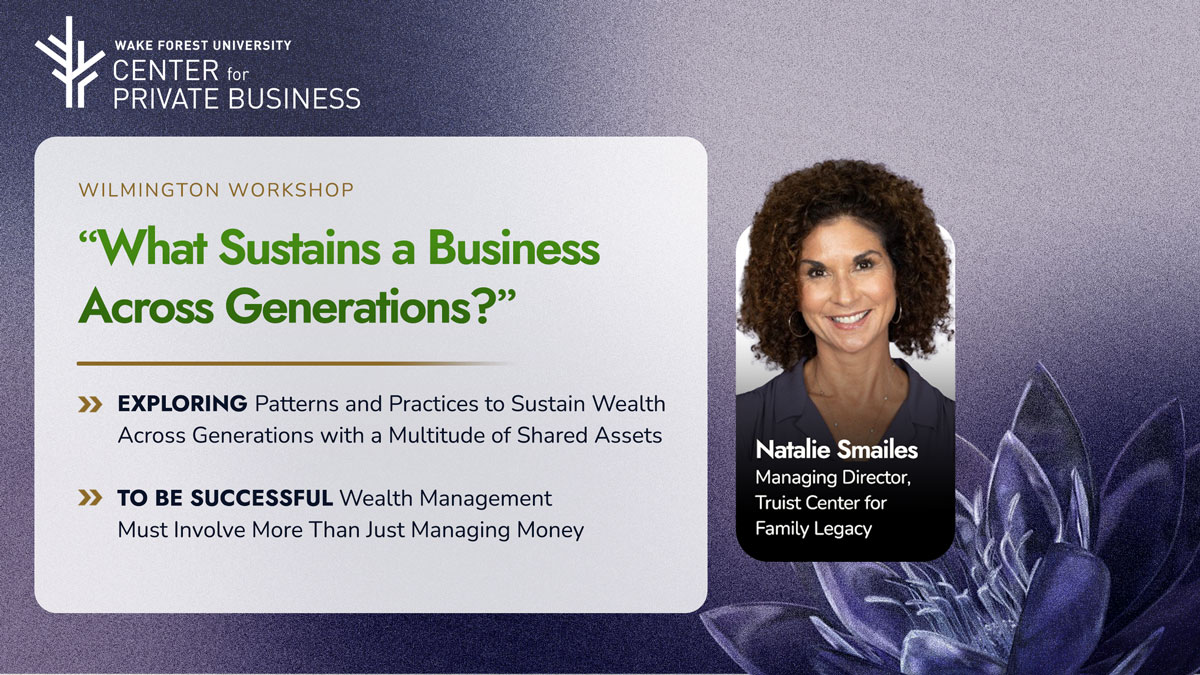

October 14, 2026 | Wake Forest University Center for Private Business | Wilmington
This page accompanies Natalie Smailes’ October 14 Lunch & Learn with the Wake Forest University Center for Private Business. It draws on published research from the Truist Wealth Center for Family Legacy to provide additional context, findings, and practical questions beyond those discussed during the presentation. It is intended as a reference for attendees who want to explore the subject further.
What allows some families to sustain their wealth and legacy across generations while others struggle?
Natalie Smailes, Managing Director of Truist Wealth Center for Family Legacy, shares insights drawn from the Center’s more than 30 years of work helping families sustain wealth across generations.
The research suggests that financial planning alone is not enough. Communication, trust, shared values, family governance, and preparing future generations all play important roles.
In the late 1990s, family wealth advisers began examining why some families successfully transferred wealth across multiple generations while others did not.
Their work revealed that financial planning, while essential, was only part of the picture. Successful families also developed what researchers call human and intellectual capital: the knowledge, relationships, values, and decision-making abilities needed to sustain a family legacy.
In 2004, Truist Wealth Center for Family Legacy (CFL) published The 25 Best Practices of Multi-generational Families, developed through interviews with families and collaboration with experts.
CFL subsequently developed its Wealth Priorities assessment to understand how families viewed and applied these practices.
Between 2004 and 2020, 679 individuals from 120 wealthy families completed the assessment. The participants represented families whose wealth transitions spanned one to five generations.
The findings were published in Bridging Beliefs and Behaviors: Key Insights into Effective Wealth Transfer Across Generations.
Research cited by CFL suggests the odds of sustaining family wealth across generations may be as low as 30%.
The research attributes:
From Roy Williams and Vic Preisser, Preparing Heirs, 2003, as cited by the Center for Family Legacy.
The implication is significant: while financial and legal planning remain essential, many of the greatest challenges to multigenerational success arise from the relationships, capabilities, and decision-making processes within families.
A family may have a carefully constructed estate plan and still be unprepared to manage the responsibilities that accompany it.
CFL organizes its 25 best practices into six interconnected categories, each addressing a question families must answer as they plan for the future.
Who are we, and what do we stand for?
Successful families understand and communicate their shared identity. They preserve family history, develop shared values, and establish expectations for how family members interact.
The five practices are family history and culture, shared values, family mission statement, teamwork and communication, and family member well-being.
Who leads, and how will we work together?
As families grow, decision-making becomes more complicated. Governance creates a framework for establishing authority, making decisions, managing disagreements, and preparing future leaders.
The five practices are family decision-making, family meetings, family policies, conflict resolution, and succession planning.
How will we prepare future generations to manage the family legacy?
Preparing heirs involves more than teaching financial literacy. Families must also help younger generations develop judgment, responsibility, independence, and the ability to manage relationships affected by wealth.
The five practices are financial education, parenting skills, support for entrepreneurship, family support networks, and understanding money and relationships.
What are our goals, and are we prepared for major life events?
Families need agreed-upon objectives that extend beyond the current generation. They must also anticipate events that could affect their wealth, relationships, and decision-making.
The three practices are economic aptitude, wealth objectives, and planning for major life events.
How will we ensure long-term financial growth and stability?
Legal and financial structures must support a family’s objectives. Equally important is ensuring that family members understand the intentions behind those structures and are prepared for the responsibilities they create.
The four practices are communicating intentions, grantor and beneficiary mentoring, selection of trustees and advisers, and trustee and beneficiary relationships.
How will we give back?
Philanthropy provides families with opportunities to express shared values, develop decision-making capabilities, and work together toward common goals.
The three practices are supporting individual philanthropy, shared family philanthropy, and strategic philanthropy.
These categories are interconnected. Shared values inform governance. Governance clarifies who makes decisions. Mentoring prepares future decision-makers. Strategic planning establishes long-term objectives, while trusts, estates, and philanthropy help families act on those objectives.
Not every family needs to implement all the practices at once. CFL encourages families to identify those most relevant to their circumstances and develop a plan around their priorities.
One of the most revealing findings from CFL’s research is the difference between what families believe is important and what they actually practice.
Participants in the Wealth Priorities assessment evaluated each best practice according to its importance, their family’s level of engagement, and the perceived consequences of engaging or not engaging, and the gaps were substantial.
|
Best Practice |
Rated Highly Important |
Reported High Engagement |
|
Teamwork and communication |
97% |
36% |
|
Financial education |
96% |
29% |
|
Succession planning |
86% |
21% |
|
Conflict resolution |
82% |
12% |
Source: Truist Wealth Center for Family Legacy, Bridging Beliefs and Behaviors, 2025.
These four practices had gaps exceeding 60 percentage points between perceived importance and high engagement.
The gap between belief and behavior does not necessarily indicate that families are indifferent. In many cases, they recognize the importance of a practice but have not developed the processes, skills, or willingness to put it into action.
The research also examined whether family members believed their level of engagement affected their ability to sustain wealth.
Among respondents who reported that their family did not engage in teamwork and communication, 90% believed that lack of engagement was detrimental to successful wealth transition.
Families also recognized that today’s unresolved issues could become tomorrow’s problems.
When asked which gaps in their family practices could have negative consequences following a major life event, such as the death of a family member:
These responses suggest that families often recognize risks well before circumstances force them to confront those risks.
CFL’s research identified recurring obstacles to implementing important family practices.
Family members described situations where those with decision-making authority were reluctant to discuss succession because they feared conflict or losing control.
Some reported that only a few individuals understood the family’s financial plans.
Others described unresolved disagreements, painful family experiences, or communication patterns that made meaningful discussions difficult.
These challenges can reinforce one another. Without clear governance, family members may be uncertain about their roles. Without clear roles, succession discussions can become contentious. Fear of contention can then prevent the conversations needed to establish clarity.
One particularly important practice is communicating estate planning intentions.
Parents may hesitate to share their intentions because they worry about demotivating children, creating conflict over unequal inheritances, or losing the flexibility to change their plans.
Yet CFL’s experience suggests that discussing these intentions often produces better communication, greater trust, clearer expectations, and better-prepared heirs.
The goal is for family members to understand the decisions, the intentions behind them, and their own responsibilities.
One of CFL’s more practical observations is that well-prepared families do not simply assume they are ready for major transitions; they test their preparedness.
Families can walk through hypothetical events, such as the unexpected death of a family leader, a divorce, a serious illness, or the sale of a business.
They examine what would happen, who would make decisions, what information would be needed, and whether those responsible are prepared.
These exercises, which CFL describes as fire drills, can reveal vulnerabilities while there is still time to address them.
For a family that owns a business, the exercise might begin with a straightforward question:
If the person currently leading the business were suddenly unavailable, would the family know who has the authority, information, and capabilities to make the next important decisions?
CFL recommends that families develop an approach suited to their circumstances rather than attempt to implement every practice simultaneously. Its research offers a starting point for each category.
Family Cohesiveness: Document and share your family’s history. Discuss the values and principles that define your family and establish expectations for respectful communication.
Governance: Clarify current and future leadership responsibilities. Establish processes for making decisions, addressing conflict, and holding regular family meetings.
Mentoring: Identify family members who have both the desire and the potential capability to assume future responsibilities. Develop the knowledge and skills they will need. As CFL emphasizes, both will and skill matter.
Strategic Planning: Establish written wealth objectives for the next five, ten, and twenty-five years. Ensure they reflect the family’s mission and values.
Trusts and Estates: Prepare beneficiaries for their future responsibilities. Communicate the intentions behind wealth distribution and address potential disagreements through open dialogue.
Philanthropy: Discuss whether and how the family wishes to give back. Identify shared values and develop an approach that reflects them.
The objective is steady progress toward building the capabilities a family needs for its particular circumstances.
Drawing on Natalie’s presentation and CFL’s research, consider these questions about your own family:
What matters is understanding which capabilities your family needs, which are already in place, and which need deliberate attention.
The following Truist resources provide additional research, frameworks, and practical guidance on sustaining family wealth across generations.
Bridging Beliefs and Behaviors: Key Insights into Effective Wealth Transfer Across Generations, Truist Wealth Center for Family Legacy, 2025
An examination of 16 years of Wealth Priorities assessment data from 679 individuals representing 120 wealthy families. Includes findings on the gaps between perceived importance and actual engagement across all 25 best practices.
Read the research at Truist Wealth
The 25 Best Practices of Multi-generational Families, Truist Wealth Center for Family Legacy
The foundational paper describing the 25 non-financial practices, their importance, and how they contribute to sustaining wealth across generations.
Contact Jenna Yingling at Jenna.Yingling@truist.com for this information.
About Truist Wealth Center for Family Legacy
The Center works with families to develop the human and intellectual capital required to sustain their legacy. Its services include family governance, education, succession planning, family office advisory, and guidance through major family and business transitions.
Learn more about the Center for Family Legacy
For additional information about the research or the Wealth Priorities assessment:
Research findings presented here concern multigenerational family wealth and should not be interpreted as statistics about the survival rates of family-owned operating businesses. The findings reflect research cited by Truist and assessments completed by CFL client families.
Presented by the Wake Forest University Center for Private Business, Wilmington.
The Center for Private Business convenes leaders of privately held businesses to exchange ideas, learn from experienced practitioners, and strengthen the long-term success of their organizations.
Learn more about the Wake Forest Center for Private Business
The Center for Private Business provides business owners with peer networks we call Forums, expert programming, and confidential space to work through decisions like these before they become urgent.

Kevin works with recruitment, outreach and members in the Wilmington and Eastern North Carolina region, through Carolina Beach, Jacksonville, Morehead City, Fayetteville and New Bern.